
 IOL-Experience
 Technologies
 IOL calculators
 Service & handling
 Sustainability
 Congresses and events
 Download Center
Trifocal IOLs:
Clear vision at all distances
For increased spectacle independence and quality of life.
Multifocality for the highest standards
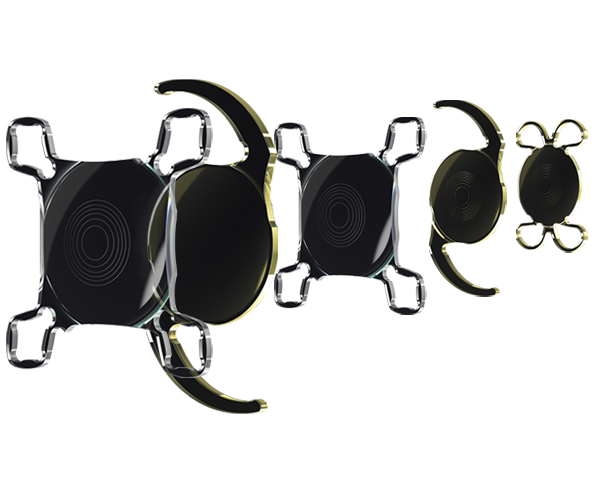
Help your cataract and presbyopia patients fulfil their desire for the greatest possible spectacle independence: multifocal intraocular lenses from 1stQ provide clear near, intermediate and distance vision, significantly improving your patients’ quality of life.[1] We offer trifocal IOLs for the capsular bag and sulcus, as well as the flexible dual lens procedure Liberty².
A smart approach to flexible presbyopia correction, with reversible trifocal correction during refractive lens exchange or cataract surgery.[2–5] (2-5) Our multifocal IOLs achieve their trifocality through Elevated Phase Shift (EPS) technology, delivering excellent image quality with minimised optical disturbances.[1,4](1,4)
All trifocal IOLs at a glance

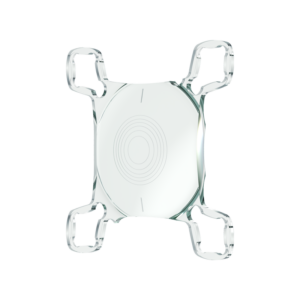
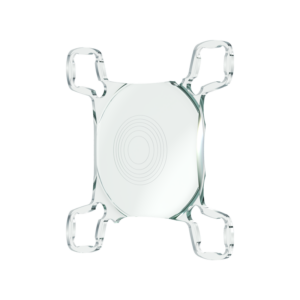
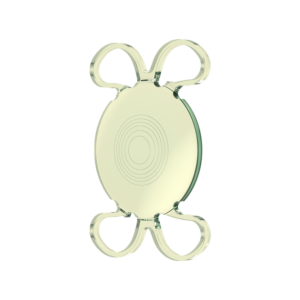
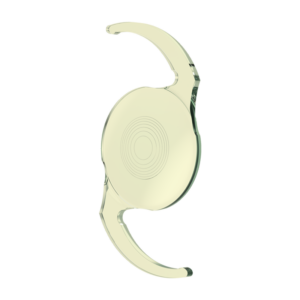
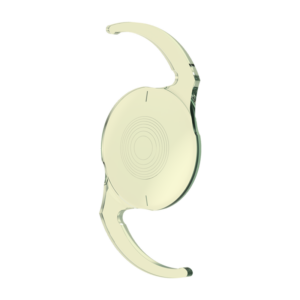
Basis Z toric-trifocal
toric-trifocal hydrophilic capsular bag lens, non‑preloaded, yellow Read moreApplications of trifocal optics
Liberty² – Flexible presbyopia correction with the dual lens procedure
The dual lens procedure Liberty² from 1stQ offers you unique freedom in presbyopia correction – in several ways.
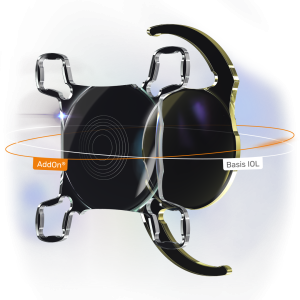
To provide your patients with flexible trifocal correction during cataract surgery or refractive lens exchange (RLE/CLE), you implant a monofocal or monofocal toric Basis IOL in the capsular bag and a multifocal AddOn in the sulcus.[5,6] (5,6) The sulcus lens is designed to be reversible, meaning it can be explanted atraumatically or exchanged for a more suitable 1stQ AddOn even years after the procedure.[2,3] (2,3)
Liberty² can be implanted with different near additions (+3.0 D; +2.25 D; +1.75 D) and is suitable for Mix & Match approaches. The wide range of capsular bag and sulcus lens combinations allows you to provide highly individualised treatment for your patients.
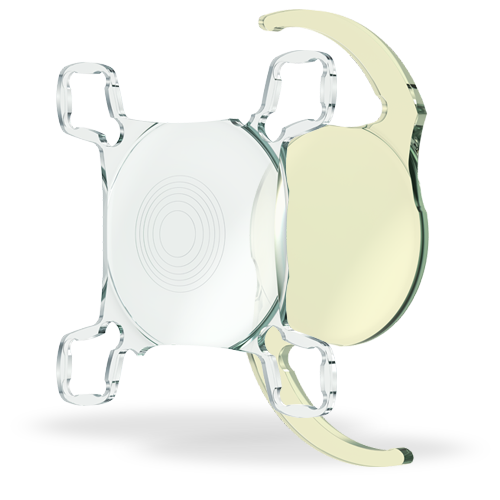
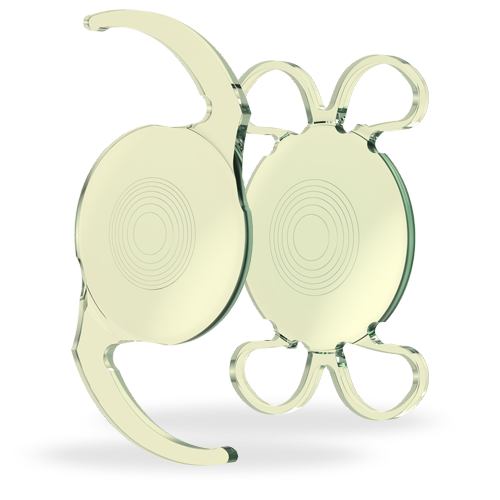
Multifocal capsular bag IOLs
1stQ multifocal IOLs for the capsular bag are available in the Basis Z and Basis Q designs.
Both models use EPS technology to achieve trifocality with excellent optical performance from near to distance using just eight diffractive steps.[1,2,4] The reduced number of diffractive steps reduces visual disturbances such as halos and glare and increases contrast sensitivity.[4] Other multifocal intraocular lenses use significantly more diffractive steps to generate multifocality.[6] Further features of our multifocal capsular bag IOLs include:
- High Abbe number (58)
- Refractive index of 1.46
- Natural Yellow blue light filter
- Reduced chromatic aberration
- Enhanced protection against posterior capsule opacification (360° sharp edge)
- Optimised A-constant
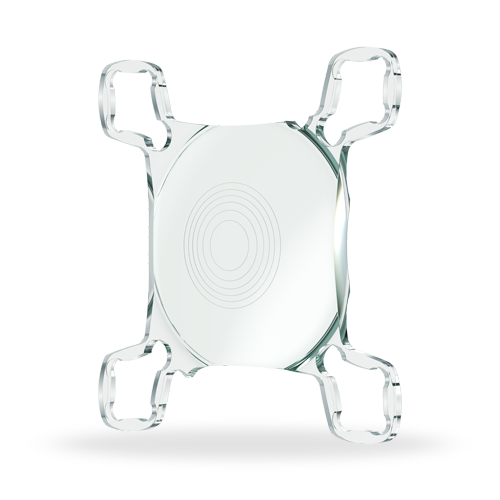
Multifocal AddOn® IOLs for upgrading pseudophakic eyes
With 1stQ multifocal IOLs for the sulcus (AddOn), you can flexibly extend the range of focus in eyes that have already received a monofocal IOL.[1] The existing capsular bag lens does not need to be explanted. The AddOn is implanted as a secondary lens in the sulcus of the pseudophakic eye.[1,4] The 1stQ AddOn features a patented design that provides secure and stable positioning in the sulcus.[4,7,8] The AddOn can also be removed or exchanged atraumatically at any time.[2,3]
The trifocal effect of the multifocal AddOn is generated using EPS technology, requiring just six diffractive steps (+3.0 D addition).[4] This enables the multifocal AddOn to provide a high level of visual comfort with reduced visual disturbances.[1,2,4] Your pseudophakic patients can therefore benefit from trifocality with excellent optical performance and achieve a high degree of spectacle independence after their initial surgery.[1]
Multifocal toric IOLs for additional astigmatism correction
We also offer multifocal IOLs with trifocal toric optics to provide clear near, intermediate and distance vision in patients with corneal astigmatism. Trifocal toric IOLs are available for implantation in the capsular bag and as AddOn® IOLs for the sulcus, providing refractive correction as secondary supplementary lenses. Both models enable precise cylindrical correction and offer high rotational stability.[7,8] (7,8)
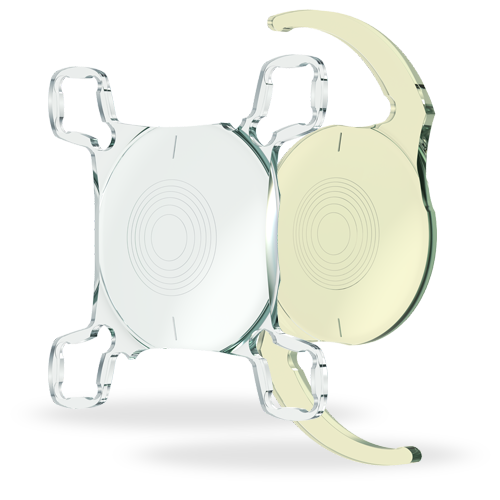
Trifocal/multifocal IOLs at a glance
| Dual lens procedure Liberty² | Trifocal/multifocal Basis IOL | Trifocal/multifocal AddOn® | Toric trifocal Basis or AddOn® IOL | |
|---|---|---|---|---|
| Application | Refractive lens exchange: flexible presbyopia correction in cataract surgery or CLE | Refractive lens exchange: presbyopia correction in cataract surgery or clear lens extraction (CLE) | Refractive upgrade: trifocality in pseudophakic eyes | Refractive lens exchange: presbyopia and astigmatism correction in cataract surgery and CLE |
| Eye status | Phakic, including eyes with astigmatism | Phakic | Pseudophakic | Phakic, pseudophakic, astigmatism |
| Positioning | Capsular bag and ciliary sulcus | Capsular bag | Ciliary sulcus | Capsular bag or ciliary sulcus |
| Technology used to generate trifocality | Elevated Phase Shift (EPS) | Elevated Phase Shift (EPS) | Elevated Phase Shift (EPS) | Elevated Phase Shift (EPS) |
| Material | AddOn®: hydrophilic acrylic; Basis: hydrophilic or hydrophobic acrylic | Hydrophilic acrylic | Hydrophilic acrylic | Hydrophilic acrylic |
| Haptic options | Basis: C-loop haptics, Z-haptics, multi-loop haptics; AddOn®: four flexible haptics | Multi-loop haptics, Z-haptics | Four flexible haptics | Basis: Z-haptics; AddOn®: four flexible haptics |
| Atraumatic reversibility | Yes (2,3) | No | Yes (2,3) | No (Basis) Yes (AddOn®) (2,3) |
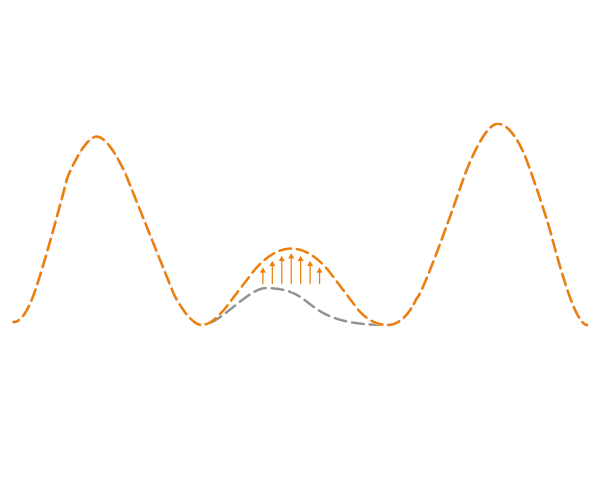
Trifocality through elevated phase shift
1stQ uses innovative EPS technology. This means: optimized image quality, minimized glistening and outstanding trifocal performance. (1)
EPS technology
Frequently asked questions about our multifocal IOL solutions
Multifocal IOLs are intraocular lenses with more than one focal range, providing clear vision at different distances. They include various IOL types, such as trifocal IOLs. Trifocal IOLs incorporate three focal ranges, covering all relevant viewing distances – near, intermediate and distance – and can therefore enable spectacle independence. Older multifocal IOLs, for example, have only two focal ranges and are referred to as bifocal IOLs.
Trifocal IOLs are therefore an advanced, modern form of multifocal intraocular lens.
Thanks to Elevated Phase Shift (EPS) technology, presbyopic patients undergoing CLE or cataract surgery receive trifocal correction that delivers excellent image quality with minimised optical disturbances.[4] This gives them the opportunity to see clearly at near, intermediate and distance ranges and achieve the greatest possible spectacle independence.[1]
Our extensive multifocal portfolio includes trifocal and trifocal toric capsular bag and sulcus lenses, as well as various AddOn combinations. This allows you to find the best individual IOL solution to provide your patients with a high degree of spectacle independence and quality of life. The 1stQ multifocal portfolio therefore enables you to treat phakic patients and offer pseudophakic patients an upgrade to excellent trifocal performance.
Our multifocal IOLs for the capsular bag and sulcus use Elevated Phase Shift (EPS) technology to generate trifocality with fewer visual disturbances and excellent image quality at all three viewing ranges: distance, intermediate and near.[1,4]
The optics of 1stQ trifocal intraocular lenses are designed so that the elevated phase shift (EPS) causes light waves associated with the distance zone and the diffractive near zone to reinforce one another.[4] This creates constructive interference, generating a third focal range for intermediate vision.[4] The distinctive feature of this approach is that no additional diffractive steps are required for the intermediate range.[4]
As a result, multifocal capsular bag IOLs require just eight diffractive steps to generate trifocality (+3.5 D addition), while multifocal sulcus IOLs require only six diffractive steps.[4] Other multifocal intraocular lenses, by comparison, have 14 or more diffractive steps.[6] As visual disturbances, light scattering and light loss increase with the number of diffractive steps, 1stQ multifocal IOLs with EPS technology achieve excellent trifocal performance with optimised image quality and minimised visual disturbances.[1,2,4] (1,2,4)
Our multifocal Basis IOLs for the capsular bag offer the following features:
- EPS technology for excellent trifocal performance with fewer optical disturbances
- Biocompatible hydrophilic acrylic material
- High Abbe number of 58, reducing chromatic aberration
- Refractive index of 1.46, close to that of the crystalline lens
- Extended PCO prevention thanks to 360° sharp edge design as cell barrier
- Optimised A-constants for reliable achievement of the target refraction
- Integrated UV filter as standard
- Natural Yellow blue light filter for natural colour perception and enhanced retinal protection
- Choice of multi-loop haptics or Z-haptics
- Also available with trifocal toric optics (Basis Z, AddOn)
In addition to the features of trifocal Basis and AddOn® IOLs, the toric trifocal IOLs offer a cylinder range of +1 to +6 dioptres (Basis) or +1 to +4.5 dioptres (AddOn) for precise astigmatism correction.
The toric trifocal Basis IOL features Z-haptics, while the toric trifocal AddOn has four flexible haptics, as do the other AddOn lenses. Both haptic designs ensure stable positioning in the capsular bag or sulcus, respectively.[7,8]
Our multifocal AddOn IOL allows you to offer patients with monofocal IOLs who desire spectacle independence an upgrade to excellent trifocal performance.[1,4](1,4) The trifocal AddOn is implanted in the pseudophakic eye and can be removed or exchanged atraumatically at any time.[2,3](2,3) It is compatible with all commonly used capsular bag lenses and is also available in a trifocal toric version.
Like all 1stQ AddOn IOLs, the trifocal and trifocal toric AddOn lenses also offer the following features:
- Suitable for almost any sulcus shape thanks to four flexible haptics
- High rotational stability through their non-torque design [7,8]
- No iris capture thanks to their square design [9]
- Rounded edges to prevent iris chafing and pigment dispersion [9]
- No contact with the capsular bag IOL thanks to their convex–concave optical design [9]
The dual lens procedure Liberty² with a multifocal AddOn offers a flexible way to correct presbyopia in a single surgical session.[5,6] A monofocal or monofocal toric Basis IOL is implanted in the capsular bag, with a free choice of all available variants. Trifocality is provided by the multifocal AddOn (+3.0 D addition), which is implanted in the sulcus.
The AddOn remains atraumatically reversible even after many years, providing a high degree of flexibility.[2,3] (2,3) The dual lens procedure Liberty² also offers economic advantages, with uniform pricing regardless of the optical combination or lens powers – including toric versions.
Multifocal IOLs with trifocal optics are particularly suitable for patients who want clear vision at all distances without relying on glasses. As people maintain active lifestyles into later life, more and more patients have high expectations of their vision and come to the practice with a clear desire for spectacle independence. Aesthetic considerations are also becoming increasingly important. For these patients, trifocal IOLs can offer a substantial improvement in quality of life.
Trifocal IOLs may also be a useful solution for patients who find glasses inconvenient in everyday life or when pursuing their hobbies.
Liberty² is particularly relevant to younger patients aged 45 and over with advanced presbyopia who are considering clear lens extraction (CLE), are still working and lead active lifestyles. Their eyes need to keep up with both everyday and digital demands, so these patients often have very high expectations of their vision and regard glasses as an obstacle. Liberty² may also be a good option for cataract patients with a strong desire for spectacle independence.
If visual preferences or the physiological condition of the eye change over the years, the flexible multifocality offered by Liberty² can be particularly advantageous. As the AddOn can be removed atraumatically, it offers a flexible safety option.[2,3] This also applies to patients whose ocular status makes multifocal outcomes difficult to predict preoperatively, such as patients with retinal conditions or those who have undergone LASIK.[3]
Yes. The multifocal AddOn enables pseudophakic patients to receive a subsequent upgrade to trifocality at any time.[1] The AddOn is implanted in the sulcus in addition to the existing monofocal capsular bag lens. The AddOn remains atraumatically reversible at any time should explantation or exchange of the sulcus lens become necessary.[2,3] (2,3)
The new ‘Match & Mix’ lens concept with RALV® may be particularly beneficial for these patients. The combination of a trifocal IOL in one eye and an EDOF or Mono+ IOL in the other eye can enable patients to be free from spectacles whilst experiencing even fewer dysphotopsias. (1-4) With the innovative RALV device, your patients can also test IOL combinations pre-operatively and find out in advance whether the multifocal option is suitable for them.(1,5)
(1) 1stQ data collection DOC 2026; data on file
(2)Naujokaitis T, Łabuz G, Khoramnia R, Auffarth GU. Review of Mix-and-Match Approach and Binocular Intraocular Lens Systems. J. Clin. Med. 2025;14:4263. https://doi.org/10.3390/jcm14124263
(3)Rakhimova M, Aldasheva N, Auyezova A, Orazbekov L, Utelbayeva Z, Svetlanova S, Karibayeva I. Visual Outcomes After Mix-and-Match Implantation of Trifocal and Extended Depth-of-Focus Intraocular Lenses: A Systematic Review and Meta-Analysis. Medicina (Kaunas). 2026;62(6):1112. https://doi.org/10.3390/medicina62061112
(4)Niknahad A, Łabuz G, Muzyka-Woźniak M, Yildrim TM, Son HS, Auffarth GU. An Update on Intraocular Lens Technology for Presbyopia Correction and Visual Outcomes. Med Sci (Basel). 2026;14(2):299. https://doi.org/10.3390/medsci14020299
(5)La Schiazza O, Kornfeld M, Brezna W, Dragostinoff N, Plank N, Socías R. Leistungsbewertung eines Sehsimulators für Intraokularlinsen. Ophthalmologie 2026. https://doi.org/10.1007/s00347-026-02451-7
All 1stQ IOLs
at a glance
Browse through our comprehensive overall portfolio of Basis IOLs for the capsular bag and AddOn® IOLs for the sulcus.

Want to get in touch with us?
Questions about our products or services? We will respond to your request promptly.
"*" indicates required fields
Literature and references
(1)Palomino-Bautista C, Sánchez-Jean R, Carmona Gonzales D, Romero Domínguez M, Castillo Gómez A. Spectacle independence for pseudophakic patients – Experience with a trifocal supplementary add-on intraocular lens. Clin Ophthalmol. 2020; 14:1043–1054. https://doi.org/10.2147/opth.s238553
(2)Khoramnia R, Baur ID, Yan W, Łabuz G, Auffarth GU Comparison of a Presbyopia-Correcting Supplementary Intraocular Lens Combination and a Capsular-Bag Lens: An In Vitro Study. Diagnostics 2023, 13, 1482. https://www.mdpi.com/2075-4418/13/8/1482.
(3)Gundersen KG, Gjerdrum B, Potvin R. Efficacy of a Secondary Trifocal Sulcus IOL in Providing Near and Intermediate Vision in Patients with Prior Myopic Laser Vision Correction and Cataract Surgery. Clinical Ophthalmology 2022;16:2219-2226. https://doi.org/10.2147/opth.s372925
(4)Presbyopia correcting IOLs for phakic and pseudophakic eyes. Eurotimes Suppl. February 2020.
(5)Harrisberg BP, Chua AW, Chua MJ, Taher A Comparison of Primary Duet Lens Procedures: In-The-Bag Monofocal with Sulcus Multifocal, and Standard Single Multifocal Lens for Cataract Surgery. Clinical Ophthalmology 2023;17:273-282. https://doi.org/10.2147/opth.s396472
(6)Presbyopiekorrektur mit dem Zweilinsensystem Liberty². Ophthalmologische Nachrichten (Sonderveröffentlichung) 2019.
(7)Patent #EP 12 181 744 (2013).
(8)Mrochen M (et al). Safety of modern dual-lens systems. Model-based investigation with regard to position tolerance and effects on the optical system. Ophthalmo Chirurgie (special publications, parts 1-3) 2013.
(9)Add-On-Intraokularlinsen – flexible Effizienz, effiziente Flexibilität oder beides? Ophthalmologische Nachrichten (Sonderveröffentlichung) 2021.